
The Observation That Triggers the Theory
The foundation of most business decisions is assumed to be rational. Investors evaluate ideas, markets, numbers, and execution potential. On the surface, capital appears to move toward opportunity. However, in practice, decisions are often made long before any of those elements are fully considered. They are made at the level of human behaviour.
A situation presented itself where an individual sought investment into her business. The amount was not significant. It was not a high-risk capital allocation. Even a modest contribution, something as small as one hundred pula within the Botswana context, would have been sufficient to test engagement and signal support. Under normal analytical conditions, such a request would be evaluated on the basis of viability, market positioning, and execution potential.
That is not what determined the decision.
The determining factor was a pattern of emotional response. In interactions involving relatively small matters, the individual demonstrated disproportionate reactions. Minor disruptions triggered visible emotional volatility. The responses were not isolated incidents but repeated patterns. What was being observed was not personality variation or momentary frustration. It was a consistent structure of response.
At that point, the evaluation shifted. The question was no longer whether the business could work. The question became whether the individual could operate within a business environment where pressure is constant, uncertainty is normal, and outcomes are rarely controlled.
The decision not to invest was made on that basis.
This is where the theory of Emotional Elasticity begins.
Elasticity in Economics – The Original Framework
Elasticity is a well-established concept in economics. It measures the responsiveness of one variable to changes in another. The most common application is price elasticity of demand, which assesses how demand changes when price changes.
When demand is elastic, a small change in price produces a large change in demand. When demand is inelastic, even a significant change in price produces little to no change in demand. This concept allows economists to understand how sensitive systems are to external shifts.
The importance of elasticity lies in its predictive power. It provides insight into how systems behave under pressure. It allows for anticipation of reaction based on stimulus.
The critical insight is that systems do not respond uniformly. They exhibit varying degrees of responsiveness depending on their structure.
This concept can be extended beyond markets.
Translating Elasticity into Human Behaviour
Human beings operate as response systems. They are constantly interacting with external stimuli, including stress, success, failure, conflict, delay, and uncertainty. Each of these stimuli triggers a response, and the nature of that response varies significantly between individuals.
Emotional Elasticity can therefore be defined as the degree to which an individual’s emotional state changes in response to external events. It is not simply about whether someone reacts, but how proportionate that reaction is relative to the stimulus.
Some individuals exhibit high responsiveness, where minor triggers produce significant emotional shifts. Others exhibit low responsiveness, where even major events produce minimal emotional change. Between these extremes lies a range of response patterns that determine how individuals function under pressure.
This is not a soft characteristic. It is a structural trait that directly influences decision-making, performance, and long-term outcomes.
The Emotional Elasticity Spectrum
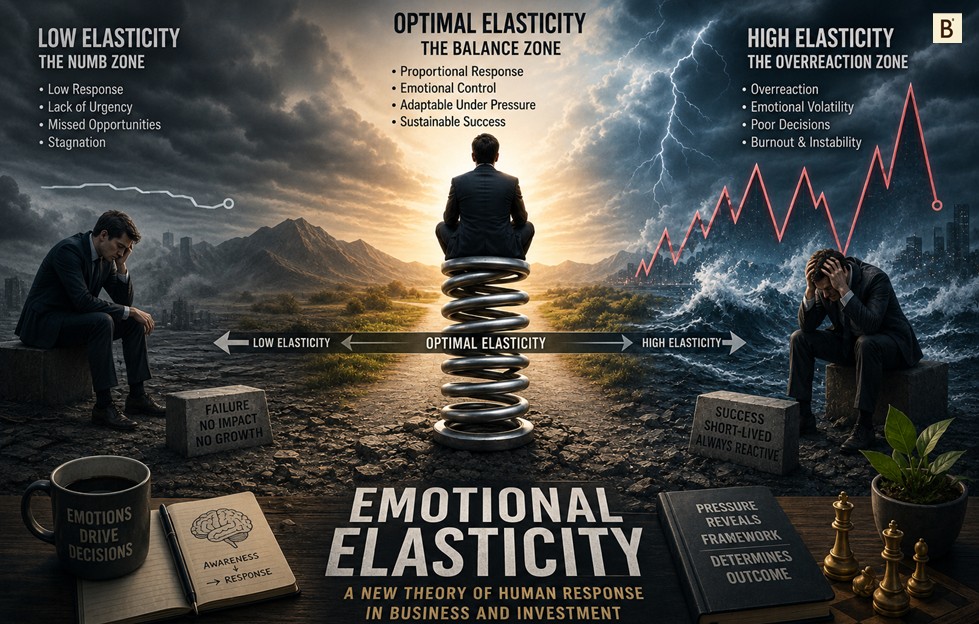
Emotional Elasticity exists along a spectrum defined by three primary zones: high elasticity, low elasticity, and optimal elasticity. Each zone represents a different response structure, and each carries distinct implications for performance and stability.
High elasticity is characterised by over-responsiveness. Low elasticity is characterised by under-responsiveness. Optimal elasticity represents proportional responsiveness, where reactions are aligned with the scale of the stimulus.
The presence of elasticity is not the issue. The position on the spectrum is.
High Emotional Elasticity – The Volatility Risk
High Emotional Elasticity manifests as a tendency to overreact to relatively small stimuli. Minor disruptions trigger significant emotional responses. These responses may include frustration, anger, withdrawal, or visible instability. The individual’s emotional state becomes highly sensitive to external variation.
In a controlled environment, this may be perceived as expressiveness or passion. In a business environment, it becomes a liability.
Business operations are inherently unstable. Delays occur, suppliers fail, customers change behaviour, cash flow fluctuates, and plans rarely unfold as expected. Each of these events introduces pressure. For an individual with high emotional elasticity, these pressures are amplified.
The result is compromised decision-making. Emotional spikes interfere with rational assessment. Reactions become immediate rather than considered. Relationships are strained as responses become unpredictable. Over time, the system destabilises.
The key issue is not the presence of emotion. It is the scale of response relative to the trigger. When small issues produce large reactions, larger issues become unmanageable.
From an investment perspective, this introduces a clear risk. Capital amplifies pressure. What is manageable at a small scale becomes critical at a larger scale. If emotional volatility is present at low levels of stress, it is likely to escalate under greater pressure.
High emotional elasticity therefore represents a volatility risk within any capital-backed environment.
Low Emotional Elasticity – The Dead Zone
At the opposite end of the spectrum lies low emotional elasticity. This is characterised by minimal responsiveness to external stimuli. Significant events produce limited emotional change. The individual appears stable, but this stability is often a function of detachment rather than control.
In a business context, this creates a different type of risk.
Low responsiveness reduces urgency. When problems arise, the lack of emotional engagement delays corrective action. When opportunities present themselves, the lack of excitement limits initiative. The individual does not experience the necessary internal signals that drive adaptation and improvement.
This extends to success. Achievements do not produce a strong positive response, reducing motivation to sustain or expand performance. The system remains flat, regardless of input.
While high elasticity leads to instability, low elasticity leads to stagnation. The system does not collapse, but it does not progress.
From a performance perspective, this is equally limiting. The absence of emotional variation reduces the capacity to respond dynamically to changing conditions.
Low emotional elasticity therefore represents a stagnation risk within performance-driven environments.
Why Both Extremes Fail
The critical insight within Emotional Elasticity Theory is that both extremes lead to failure, but through different mechanisms.
High elasticity prevents the sustainability of success. The individual is unable to stabilise under pressure. Positive outcomes are quickly overridden by negative reactions, and consistency is lost.
Low elasticity prevents the experience of success. The individual does not fully engage with outcomes, reducing both motivation and adaptive response. Opportunities are missed, and performance remains static.
In both cases, the system fails to optimise.
The objective is not to eliminate emotional response. It is to align it with the scale of events.
Optimal Emotional Elasticity – The Investor Zone
Optimal Emotional Elasticity represents a balanced response structure. The individual reacts proportionately to external stimuli, maintaining control while remaining engaged. Emotional responses are present but regulated, allowing for both awareness and stability.
In business, this translates to the ability to operate under pressure without losing decision quality. Challenges are recognised and addressed without triggering instability. Success is acknowledged without leading to complacency. The system remains responsive but controlled.
This is the emotional architecture required for scalable performance.
From an investment perspective, this is the zone of interest. Capital requires stability under pressure. It requires individuals who can absorb variability without destabilising operations. It requires decision-makers who can navigate uncertainty without overreacting or disengaging.
Optimal emotional elasticity is therefore not an abstract concept. It is a functional requirement for leadership and investment.
The Investment Principle – Evaluating Emotional Elasticity
Traditional investment frameworks focus on ideas, markets, and execution plans. These elements are necessary but insufficient. They assume that the individual driving the business can operate effectively under pressure.
Emotional Elasticity Theory challenges that assumption.
Before capital is deployed, the critical question is not only whether the idea can work, but whether the individual can manage the conditions that come with capital. These conditions include increased expectations, higher stakes, and amplified consequences.
Emotional elasticity becomes a screening tool. It allows investors to assess how individuals respond to small pressures as an indicator of how they will respond to larger ones.
This shifts the evaluation process from purely analytical to behavioural.
The Botswana Case – Field Validation
The initial observation that triggered this theory provides a clear example. The investment opportunity was not rejected due to flaws in the business idea. It was rejected due to observed emotional patterns.
The individual demonstrated high emotional elasticity in low-stakes situations. This created a predictive model for how she would respond under higher pressure. The conclusion was straightforward: if emotional instability is present at a small scale, it will be amplified at a larger scale.
The decision not to invest was therefore not a rejection of opportunity. It was a rejection of risk associated with emotional response.
This case illustrates the practical application of the theory. It is not theoretical. It is observable and actionable.
Emotional Elasticity as a Screening Tool
The implications of Emotional Elasticity extend beyond investment. It can be applied across multiple domains, including hiring, partnerships, and leadership selection.
In hiring, emotional elasticity determines how individuals will perform under workplace pressure. In partnerships, it influences conflict resolution and decision-making. In leadership, it defines the ability to guide organisations through uncertainty.
Traditional evaluation methods often overlook this dimension, focusing instead on skills and experience. Emotional Elasticity provides an additional layer of assessment that captures behavioural response under real conditions.
Why This Theory Matters in Modern Business
Modern business environments are characterised by constant change. Markets shift rapidly, competition intensifies, and uncertainty is a constant factor. In such environments, the ability to respond effectively becomes more important than static capabilities.
Emotional Elasticity determines how individuals navigate this complexity. It influences how quickly they adapt, how effectively they manage pressure, and how consistently they perform.
As business environments become more dynamic, this trait becomes increasingly critical. It moves from being a secondary characteristic to a core competency.
Response Determines Outcome
Emotional Elasticity Theory establishes that success is not determined solely by intelligence, opportunity, or resources. It is determined by how individuals respond to external conditions.
High responsiveness creates instability. Low responsiveness creates stagnation. Only proportional responsiveness allows for sustained performance.
In practical terms, this means that evaluation must extend beyond ideas and plans. It must include behavioural patterns that indicate how individuals will operate under pressure.
The decision to invest, hire, or partner should therefore be informed not only by what a person proposes, but by how they respond when conditions change.
Emotional response is not incidental. It is structural.